OREPEAK
Sincerity, Cooperation, Win-Win, Happiness
中文
Service Hotline
+86 18616111155
+86 18616111155
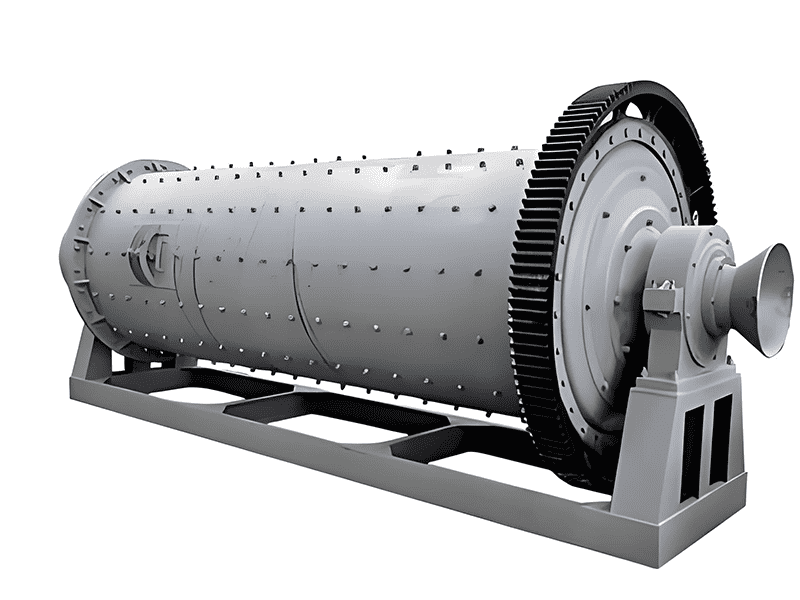
Ball mill is a key equipment for crushing materials after initial breakage. Widely applied in cement, silicate products, new building materials and other industries.
Get a Quote NowThis ball mill is a horizontal cylindrical rotating device with outer ring gear transmission, divided into two chambers, using energy-efficient grid design. Material is evenly fed into the first chamber through the feeding device. The chamber is equipped with stepped liners or corrugated liners and various specifications of steel balls. The rotation of the cylinder generates centrifugal force that lifts the steel balls to a certain height before falling, producing impact and grinding effects on the material. After coarse grinding in the first chamber, material passes through a single-layer partition plate into the second chamber, which is equipped with flat liners and steel balls for further grinding. Powder material is discharged through the discharge grate plate, completing the grinding process. Production capacity: 0.5-90 (t/h), Feed size: ≤15-≤25 (mm), Product size: 0.075-0.4 (mm), Applicable materials: Iron ore, manganese ore, tungsten ore, copper ore, ilmenite, magnetic minerals and ores. Application fields: Mining and ore processing, metallurgy and metal processing, etc.
(1) Loading and grinding media addition: Material to be ground and grinding media (usually steel balls) are added into the ball mill cylinder through the feeding device or directly.
(2) Cylinder rotation: The ball mill cylinder is driven to rotate by an electric motor, usually at a speed that generates sufficient centrifugal force and impact force.
(3) Grinding process: Inside the cylinder, material and grinding media are lifted upward, then gradually fall due to gravity. Steel balls or other grinding media impact and grind the material during falling. Impact and friction forces break and refine the material, gradually grinding large pieces into powder or fine particles.
(4) Grinding completion: Grinding media continuously impact and grind the material until the material reaches the desired fineness. The grinding time is usually set by operators according to requirements.
(5) Material discharge: After grinding, material is discharged through the ball mill discharge opening. The discharge port is usually equipped with a screen to control material particle size.
(6) Grinding media recycling: Steel balls or other grinding media, after grinding certain materials, can be recycled to continue grinding new material, saving costs and resources.
| Specification | Cylinder Speed(r/min) | Ball Loading(t) | Feed Size(mm) | Product Size(mm) | Capacity(t/h) | Power(kW) | Weight(t) |
|---|---|---|---|---|---|---|---|
| 900×2100 | 39.2 | 1.5 | ≤20 | 0.833-0.147 | 0.58-3.65 | 22 | 4.6 |
| 900×3000 | 39.2 | 2.7 | ≤20 | 0.833-0.147 | 0.8-4.5 | 30 | 5.6 |
| 1200×2400 | 32.4 | 3 | ≤25 | 0.833-0.147 | 1.1-6.8 | 45 | 9.3 |
| 1200×3000 | 32.4 | 3.8 | ≤25 | 0.833-0.147 | 1.2-7.8 | 55 | 11.2 |
| 1500×3500 | 28.5 | 6.5 | ≤25 | 0.833-0.147 | 2.4-15 | 95 | 17.8 |
| 1500×5700 | 28.5 | 9 | ≤25 | 0.833-0.147 | 3.5-20 | 130 | 23 |
| 1830×7000 | 24.1 | 15 | ≤25 | 0.833-0.147 | 6.5-35 | 210 | 43 |
| 2100×3600 | 21.5 | 19 | ≤25 | 0.833-0.147 | 8-45 | 280 | 55 |
| 2100×6000 | 21.5 | 25 | ≤25 | 0.833-0.147 | 12-50 | 380 | 67 |
| 2200×6500 | 20.8 | 30 | ≤25 | 0.833-0.147 | 14-65 | 450 | 75 |
| 2400×7000 | 20.3 | 40 | ≤25 | 0.833-0.147 | 18-85 | 630 | 92 |
| 2700×4000 | 19.3 | 45 | ≤25 | 0.833-0.147 | 22-95 | 710 | 105 |
Note: Product images, models, data, functions, performance, specifications and parameters on this website are for reference only. The above content may be improved. For specific information, please refer to the actual product and product manual.